
On the bus from Leshan to Chengdu - June 15th 2007 at dusk.
...I want traveling to be the background against which the events of my life unfold. Because we cannot reduce life to only travling; there is much more to it. There is joy and pain, love and hate, friendships and enmities, family and work, arguments and makeups, anxiety and relief, suffering and happiness. However, without giving up on any of these, I want traveling to be the stage upon which all of these necessary acts of life play out...
Two new beautiful visitors have arrived in the land of the fireworks to pay a visit to me and explore this beautiful country. Maddalena and Francesca from Italy. After intense shopping sessions at the "fakes" market in Shanghai, we were soon off to new adventures around China. Below the story of what we have seen. For my reportage on mass tourism Chinese-style and sociological experience of cruising the Yangze (in my opinion more interesting to read than what is below

) click here:
[link]
.......
Sichuan, in the West of China, is famous for its delicious, very spicy food, its chili pepper, and the laziness of its people - at least according to the Chinese from the rest of the country.
Sichuan is also home to some of the most famous landmarks of China, such as the Pandas.
These tender animals steadily on a path towards extinction - there are only about 1500 left in the world today - are protected and nurtured in a park/research facility just north of Chengdu, the capital of the province.
They live in a beautiful, large, well-maintained, natural reserve home to 130 exemplars, including a few cubs. Hidden in the bamboo forest, the Pandas make for a heartwarming view, but it does not take long to understand why their species is about to disappear from the Earth.
...Of the 60 varieties of bamboo they could eat, the really feed themselves off of only about 20, and when wild they often rather starve to death than chew on those other less tasty varieties...They spent their days eating about 20 kilos of bamboo per Panda and for the rest they sleep, sit, slowly move around, and shortly play with each other until, quickly exhausted, they pass out wherever they are...They seem to be the laziest animals in action and they also really don't like to reproduce; probably too much effort for them. Females go into heat only between February and May, but throughout these months they are only available to males one or two days. And in these 48 hours top, they must find a partner they actually like, since, such as with bamboo, they are also quite picky with sex.
...
The other famous symbol of Sichuan is the Dafu, the Great Budda of Leshan, a city about two-hours bus ride from Chengdu. With its 71 meters, this is the tallest sitting Budda in the world, carved in the rock during the 8th century under the inititative of a monk.
The statue takes up the entire side of one of the hills overlooking the river that cuts across town. A narrow and steep staircase descends the hill from the head to the feet of the Budda on the right side of the statue, and an army of tiny tourists line up to climb down and experience the feeling of being the size of an ant.
...
Apparently, Sichuan has one peculiar problem; the availability of taxis. We experienced it a few times, but the most adventurous instance was on our way out from the visit to the Dafu.
We had to catch a bus back to Chengdu right before 7pm and we thought we had plenty of time when we started hunting for a cab an hour earlier.
We were never so wrong. At the exit of the city's major tourist attraction there were no taxis in sight and the few that came by were all already taken. The only thing we found were many rikshos that would have never taken us to the bus station in time.
Left we no other choice, we hopped onto one and with our weights we nearly killed the old man who was driving it . Short of breath and clearly about to decease, the old man dropped us off after about 1 kilometer, which took him forever and a lot of sweat to complete, in an area where supposedly we could have more easily found a car.
Wrong again: very few taxis around and none free. Luckily we spotted another kind of engine-driven vehicle. A number of men where sitting on their moto-taxis and chatting by the side fo the street. We jumped onto three of those motorcycles, they put on their helmets but we were given none, and off we went on our way to the bus station, only 15 minutes left before our bus - which we had been told was the last of the day - would have left for Chengdu.
With people from the sidewalks watching the entertaining view the three of us white girls made for in such context, our moto-taxis speeded through town, passing cars from all sides, taking on wrong ways, and nearly getting us killed a few times.
To their credit, I must say, they did get us to the bus station right in time.
To their detriment, I must add, they drove us to the wrong station. And we missed the bus.
Luckily, a kind student in biology at the University of Chengdu approached us in English to let us know that from the bus station where we had ended up there was yet another bus and we were finally able to make it back to the hostel for the night.
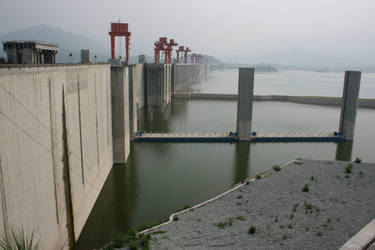
Francesca, Maddalena, and I arrived in Sichuan with a flight from Yichang, a tranquil green city in Hubei province, in the center of the country, overlooking the Yangze River. Yichang is the city closest to the humongous, and controversial, hydroelectric power plant known as the Three Gorges Dam. By the completion of the project, in 2009, Chinese authorities will have ordered the displacement of about 3 million people.
The Dam is a monster in concrete that closes off the waters of the Yangze in one of the river's widest points. Flocks of buses full of tourists visit the site and the surrounding park that houses museums, gift shops, and perfectly green, perfectly cut grass, all in the effort to project the image of the winning modernizing China, in spite of the social and environmental consequences that this project bears.
In the eyes of an outsider like me, with little knowledge of all the complexities that surround this issue and just on a quick touristy stop, what I see with my eyes, the large concrete pillars, the wide and thick iron gates that open and close to let the ships through, is a powerful reminder of what kind of an impact human beings and their actions can have on the planet and on the lives of their fellows men and women. The impression I get is that here everthing has been changed forever with the construction of the dam, environmentally, socially, economically.
Aside from its monstruosity, the Three Gorges Dam also marks the ending point of the cruises that bring tourists to navigate the Yangze. It is on one of these boats that the three of us arrived here from Chongqing, a city of 13 million that, made into one of the five speical economic zones alongside Shanghai and Tianjin, now comprise its own indipendent prefecture.
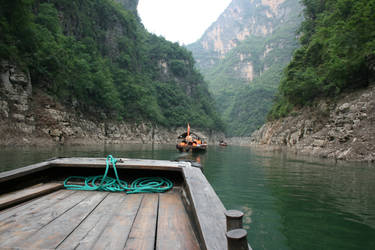
The four-stories boat navigates for three days and three nights through some truly spectacular sceneries. Although the Yangze is already a highly industrialized river and some portions of the navigation - especially the first day leaving Chongqing - are not too interesting with the surroundings invaded by factories and high-rises, when the boat finally sets foot inside the Gorges the vew becomes magnificent.
There are three big Gorges along the main course of the river that span across a couple of hundreds kilometers all together. On a side stream there are three smaller ones, and another three even smaller known as the "three mini gorges." Going from the largest to the smallest we must change boats, their sizes also decreasing in order to fit the river-bed. The smallest one is just slightly bigger than a canoe, with as many of us as possible crammed onto it.
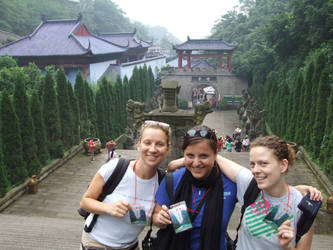
Often veiled by a thick layer of fog and heavy mist, steep cliffs fall from high up into the muddy waters, their lush sides covered in vegetation. Temples, pagodas, the residences of some students of the Confucian classics, sit along both sides of the Yangze and the boat stops regularly to allow for the visit to such sites, some of them better maintained, others more rugged and let go but nevertheless as charming.
For more on the cruise:
[link]...just a quick stop in shanghai. i'm off to beijing tonight with a night-long train ride on hard seats...will let you know how that goes
it really reminds me on my trips through china....whoa thats just an amazing experience!!!! What´re you doing there?

--
My heart is broken, but I´m out of glue. - Xiaoshui
[link]
--
CADA (Chengdu Alliance in DeviantArt 成都联盟 )
[link]
nice nice!
oh, if you meet a dissident, slap him/her and report about it, that way your blog will remain open.
--
"If you need a hero you have diminished yourself in some way"
--
And it was the most delicious badger ever.
so here is yur challenge: learn to catch a fly with chopsticks as it flies by.
Previous Page12Next Page